
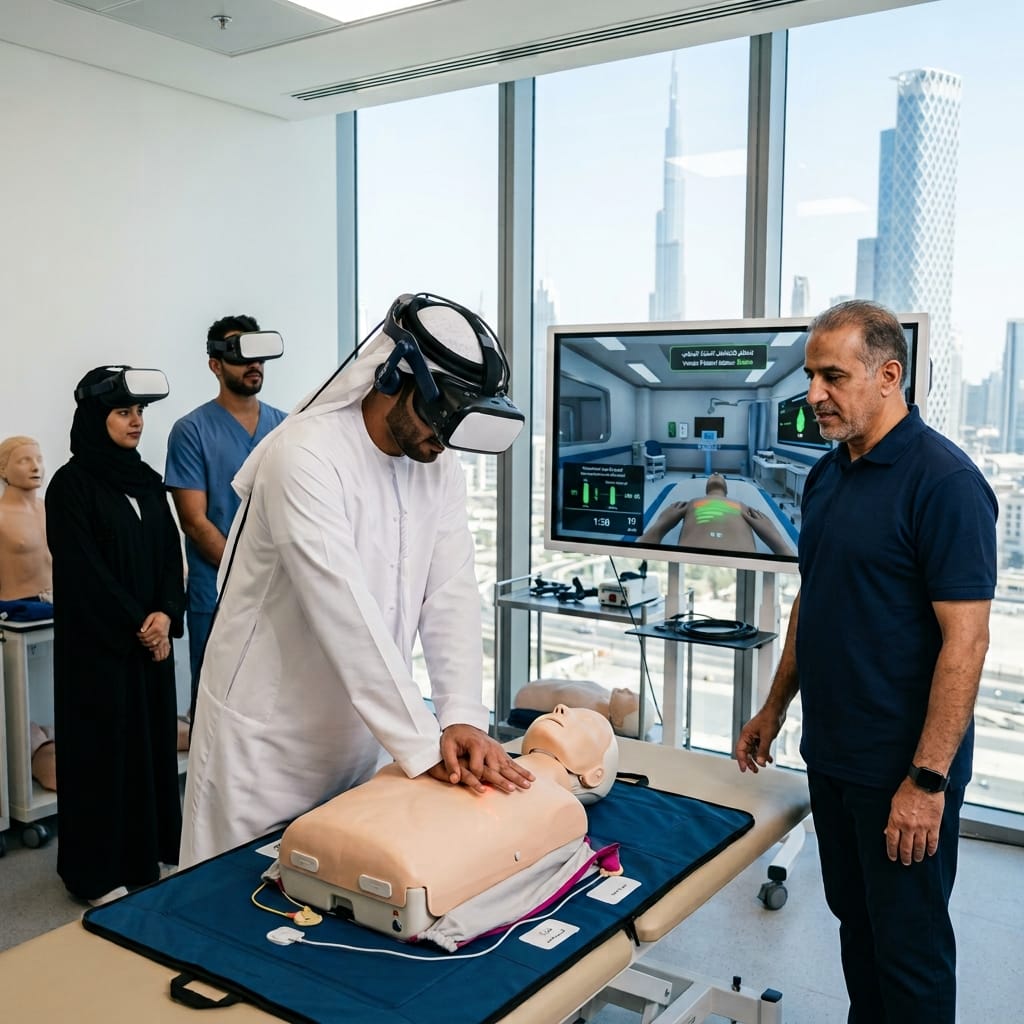
Picture this: someone collapses in front of you. Their heart has stopped. You have roughly ten minutes, really more like three or four, before the chances of a full recovery start dropping fast. Most people freeze in that moment, not because they don’t care, but because they’ve never actually felt what it’s like to perform CPR under pressure. That’s the gap CPR Training with VR Simulation in Abu Dhabi is designed to close, replacing passive lectures and mannequin demonstrations with an immersive, realistic emergency you can practice again and again until it becomes muscle memory.
Why CPR Skills Matter More Than Most People Realize
The numbers here are sobering. According to the American Heart Association (AHA), a U.S.-based nonprofit and the leading global authority on resuscitation science, immediate CPR can double or even triple a person’s chances of surviving cardiac arrest (heart.org). Yet the same research shows survival odds fall sharply for every minute that passes without intervention, and only a portion of people who experience cardiac arrest outside a hospital actually receive bystander CPR before professional help arrives (cpr.heart.org). The AHA’s “Chain of Survival” framework makes the point plainly: early recognition and immediate CPR are the first links non-medical bystanders can control, and they’re often the difference between life and death long before paramedics arrive cpr.heart.org. In other words, this isn’t a skill reserved for doctors and nurses. It’s a life skill, and Abu Dhabi’s growing focus on public health preparedness reflects exactly that.
Why VR Changes How CPR Is Actually Learned
Traditional CPR classes have a well-known problem: watching a demonstration and performing a few compressions on a mannequin in a quiet classroom doesn’t recreate the adrenaline, confusion, or decision-making pressure of a real emergency. Virtual reality closes that gap by placing trainees inside a realistic, high-stakes scenario: a collapsed person, a chaotic environment, a ticking clock, while sensors track exactly how they perform. Here’s what a typical CPR training session with VR simulation actually looks like step by step:
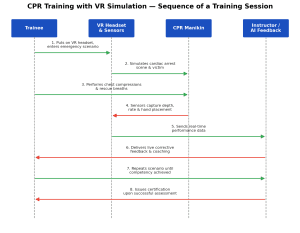
The trainee dons the headset and steps into a simulated emergency. Sensors track compression depth, rate, and hand placement in real time, feeding that data straight to an instructor or AI-driven feedback system. Corrective coaching happens immediately, not days later in a debrief, and the scenario repeats until the trainee demonstrates real competency, not just familiarity.
Virtual Reality CPR Certification UAE, What to Expect
If you’re exploring virtual reality CPR certification UAE programs, expect the course to combine three elements: foundational CPR theory (compression rate, depth, rescue breaths, AED use), immersive VR scenario practice, and a final competency assessment that determines certification. Unlike a purely video-based course, VR-based certification forces active participation, you can’t passively watch your way through it, which is precisely why retention tends to be stronger.
Hands-On Life Saving Courses Abu Dhabi, Who Should Enroll
Hands-on lifesaving courses Abu Dhabi residents pursue through VR-based CPR training tend to attract a wide range of people:
- Healthcare professionals maintaining or renewing BLS/CPR certification with more realistic scenario practice.
- Corporate teams building workplace emergency readiness, especially in industrial or high-risk environments.
- School and university staff preparing for medical emergencies involving students.
- Everyday residents who simply want the confidence to act if a loved one or stranger collapses in front of them.
What Makes the Best CPR Training Centers UAE Stand Out?
Not every provider offering “VR CPR training” delivers the same experience. When comparing best CPR training centers UAE options, look for:
- Genuine sensor-based feedback, not just a VR headset showing a video, but real tracking of compression quality.
- Certified instructors overseeing the sessions, not just automated software running unsupervised.
- Curriculum aligned with recognized resuscitation guidelines, current AHA or equivalent international standards.
- Realistic scenario variety, different settings and victim types build adaptable, real-world skill rather than a single memorized routine.
Learn CPR the Hands-On Way with ISkills.ae
ISkills.ae offers CPR training with VR simulation designed to build genuine, muscle-memory-level competence, not just a certificate. The immersive format means you practice under realistic pressure before it ever matters in real life.
Every Second Counts, Be Ready
Cardiac arrest doesn’t wait for the “right” moment, and neither should your preparation. Whether you’re renewing a professional certification or learning CPR for the first time, hands-on, VR-based training gives you the confidence and muscle memory that passive learning simply can’t. Contact Us


